It doesn’t seem like that long ago that I took up an interest in woodworking. Yet, in reality it’s been nearly 10 years since I started. From the obligatory bookshelf to progressively more detail projects and now furniture. My wife and I have a small number of people that we are close to that aren’t family. One such couple, well the Mrs., saw a river table online and we thought it would be a nice gift to make one for her after she expressed interest. Below, see the project from start to finish (kind of):
Step 1: Selecting the Wood
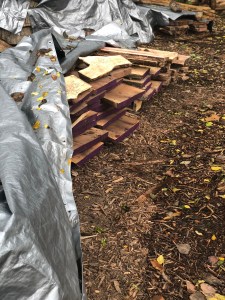
These slabs had all been drying for 3 years.
Thanks to YouTube, affordable power tools and the DIY movement, woodworking continues to explode. Which means so are the vendors. Purchasing hardwoods isn’t that difficult or expensive. Found a local who mills wood and got a great deal on some 2x20x48 inch Walnut slabs
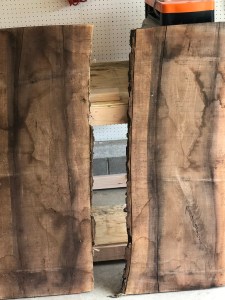
Step 2: Remove Bark
I’ve seen many live edge pieces, particularly fire place mantles and even some tables leave the bark on. However, because I’d be using the epoxy to create the river effect down the middle of the piece, I thought it would look best if I removed the bark. The clean edge would look better in the room the table would be in.

Using a chisel and hammer, I was able to remove the bark. I didn’t have to be too careful because I would follow this up with a bit of sanding using my orbital sander and 80 grit paper. However, you don’t want to cause unnecessary damage to the slab. The epoxy/resin will come into direct with this portion of the slab when creating the river.
Step 3: Find and Cut Center Line and length
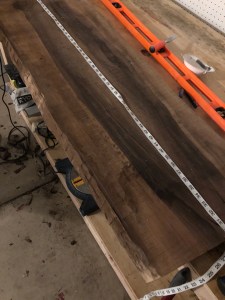
Finding the center whilst considering the pattern of the grain
After examining the slab, I wanted to find where to make my center. The plan was to split it down the middle whilst considering the grain pattern and flip the two pieces so they created a natural “river” layout between them. I also used this opportunity to begin cutting the slab to length. This would allow me to use less epoxy/resin and create an accurate form before setting the walnut in place and beginning my pour.
Step 4: Create the Form
This is a step that can be done at any point before the pour. In fact, I’ll use this form for another table and cut the wood to size. I used a 3/4in 4×8 melamine board to create my form (and later, a router sled). I cut the form to the dimensions I wanted the table to be so that it fit securely.
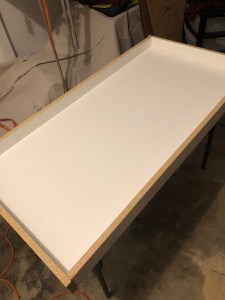
Melamine is great because of the surface material
I made a few errors at this point, not concerning the form, but the function was effected. I like to use melamine because it’s strong and the surface material allows the table to be removed extremely easy without damaging either piece. I also used Green Frog tape to ensure no leaks in the creases. (This would later prove to have been a great idea if I didn’t miss something else and I still recommend it be done.)
Step 5: Insert Walnut into Form
Before inserting the boards, I ran them through my 13.5inch planer to uniformly flatten them and create less sanding at the end of the project. Its important to understand why I didn’t put the dimensions of my wood or form. This is completely up to you. I’d suggest following traditional dimensions for what ever is the piece you are building (TheSpruce.com has some helpful tips here.)

This is where I made my first mistake. The form was so snug that I didn’t realize that the board on the right was not completely flat against the form and was slightly up. Even after putting items on top to keep the pieces from floating during the pour.
Step 6: Mix Epoxy, Resin and Color (Optional) and Pour
I used Crystal Clear Epoxy and Resin because it had fairly good reviews and wasn’t as expensive as some of the similar brands. For my color I used Stardust Micas Pigment Powder . This epoxy/resin mix was one to one and easy to mix completely. As I stated in the above steps, I weighted the two cuts down so that they wouldn’t float and proceeded with my first pour.
After following the clear instructions on the mix label, I repeated the pour steps until my mix had reach a volume to be flush with the thickness of the wood. You don’t want to be wasteful and have too much epoxy/resin mix. To calculate volume multiply the average width x thickness (height) x length.
Step 7: Flatten
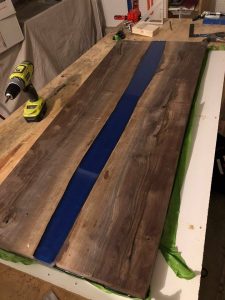
You can see some of the tape still stuck because of the uneven insert.
The good news was that the melamine was as easy as anticipated to remove from the wood. As I mentioned earlier, the right side board wasn’t perfecting flat against the melamine and epoxy seeped underneath. This created two problems: 1. The table was no longer perfectly flat. 2. The leaked epoxy/resin had created a hard shell around the tape on the right side. Because of this I had to make a router jig/sled to flatten the underside of the table and remove the tape (I’ll post a link to that build once it’s posted).
Step 8: Sand, Finish and attach the Legs
This was by far the easiest part. Having been very careful about the plane and flattening, the sanding went extremely well. I went from 80 grit to 150 grit to 220 grit and got a fine and smooth surface. There are so many options in finishing that it comes down to function (first) and then preference. If your piece is going to be lightly used, you may be able to stop here. You can add Danish oil to bring out the color of the wood. I knew this table was going to get a good amount of use so I had to add protection to the top surface without changing its appearance too much.
I used a Walnut Danish oil to seal, finish and protect the surface from the use it would endure. I added the pin style iron legs to keep a slim profile.
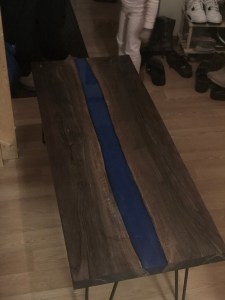
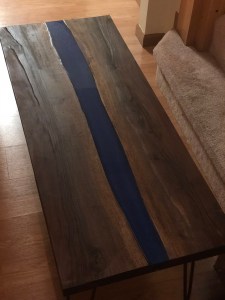
This was an enjoyable build and I learned a good amount during this. While I like the outcome, there will be several things I do differently next time. If you’ve made it this far, thanks for reading and God bless!
 Darell Houseton